1. Introduction
This document provides key policies and procedures that should be followed when submitting models of golf clubs and other equipment to the USGA for conformance evaluation. A model of club is defined as one in which all of the individual samples have been designed and manufactured to be identical, within reasonable manufacturing tolerances, including the external markings and appearance of the club, except that there may be a variety of lofts and bounces.
If the design, manufacture or construction of a club or other equipment is changed or updated such that the new version is different in appearance, may perform differently from previously-submitted samples, or is marked differently, a sample of that club or other equipment should be re-submitted as a different model which is distinguishable from the previous version by an identification marking (for clubs, see Section 7 below on Clubhead Markings).
While many of the following procedures will be familiar to previous submitters, we ask that you review the entire document so that you are aware of the most up-to-date submission information. This will help to ensure that processing of equipment submitted to the USGA for conformance evaluation is performed in an accurate and timely manner. As a reminder, several golf club testing protocols are available here.
Also, please note that with the publication of the 2019 Rules of Golf, the Equipment Rules have been created as a stand-alone publication and are available here.
2. What to Submit
The preamble to the Equipment Rules states that “A manufacturer should submit to the USGA a sample of the equipment to be manufactured for a ruling . . . If a manufacturer fails to submit a sample, or, having submitted a sample, fails to await a ruling before manufacturing and/or marketing the equipment, the manufacturer assumes the risk of a ruling that the equipment does not conform to the Equipment Rules.”
Accordingly, submissions of new equipment to the USGA for conformance evaluation are strongly recommended, but not mandatory. The following is the USGA’s general advice to manufacturers regarding what to submit:
a) All drivers which are intended for use at the elite level of play (i.e., professional and elite amateur-level competitions that adopt Model Local Rule G-1 regarding the List of Conforming Driver Heads) and which, therefore, must be included on the List to be played (see Section 5 below).
b) Any products that have the potential to be played at the elite level. This is particularly important for irons, wedges, fairway woods and hybrids manufactured on or after January 1, 2010 which are required to meet the Impact Area Markings specifications effective from January 1, 2010 (i.e., where Model Local Rule G-2 has been adopted).
c) Any products that the manufacturer has any doubt as to whether it conforms to the Rules of Golf and the Equipment Rules.
d) Any unique, innovative designs which incorporate new material(s) and/or feature(s). Manufacturers are encouraged to submit such product early in the development cycle to avoid unnecessary costs and/or production delays (early submissions may be in the form of drawings, diagrams, descriptions, etc.).
e) Any products that the manufacturer wishes to state “Conforms with the Rules of Golf” in advertising, marketing, instructional and other material associated with the product (such materials should be provided with the submission). Permission to make a statement regarding the Rules of Golf is only granted through the official conformance evaluation process.
3. Where to Submit
The USGA and R&A jointly govern the Rules of Golf. However, each organization makes independent decisions regarding equipment submitted for evaluation of its conformance to the Rules of Golf and the Equipment Rules. Therefore, as a general rule, golf equipment covered by this guideline should be submitted to the USGA if the manufacturer is based in the United States, its territories and/or Mexico. Additionally, if a manufacturer is based outside of those areas, the manufacturer should submit product to The R&A, unless the product is intended primarily for markets within those areas.
Submission information is available here.
4. General Product Submission Information
Woods and Hybrids
Each loft of each model is considered to be separate. As a result, a sample head of each loft within a particular model line should be submitted. In addition, right-handed and left-handed heads are considered separate models. It is not necessary to submit a completely assembled club for each loft (see submission guidance below on shaft and grip components).
Irons
To obtain an official conformance decision for the set, the full set of irons must be submitted for evaluation. Like woods and hybrids, we consider right-handed and left-handed heads, as well as different finishes, to be separate models. When submitting a set of irons, one sample should be submitted in its assembled form (e.g., with a shaft and grip). The remainder of the set should be heads only.
Wedges
Wedges which are manufactured in a different finish are considered separate models and every loft within each finish is considered a separate club for submission purposes. An official decision can only be issued for a specific loft and finish combination if a sample has been submitted. While we do not require evaluation of every bounce or grind, we would encourage manufacturers to submit a cross-section of bounces and grinds. However, if an official decision has been rendered on a specific loft/finish, the conformance decision would apply to all bounces for that loft/finish. Finally, to reduce the submission cost, we combine wedge submissions received at the same time in groups of up to ten (10) and charge at the same rate as a set of irons.
Putters
To obtain an official decision, we require submission of an assembled putter (i.e., head, shaft and grip). Generally, it is not necessary to submit a right-handed and left-handed putter of identical construction. Also, we consider standard-length, mid-length and long putters to be distinct models, requiring separate submission.
Shafts
Shafts are evaluated for bending and twisting, as well as other potential conformance issues. If you have previously submitted a particular shaft intended to be used with a particular wood, hybrid, iron or wedge submission, you may refer to that shaft on the submission form and note the previous submission number. Additionally, if stock shafts are installed, there is no need to send a sample to the USGA unless there are markings specific to your company/product (though you should ensure that the shaft selected is conforming). If submitting a shaft, a sample of each flex is necessary for evaluation and should not be part of an assembly.
Grips
Grips are treated in a similar fashion to shafts with respect to submission procedures. If you have previously submitted a particular grip, you may refer to that grip on the submission form and note the previous submission number. If not, submit one non-shafted grip sample and one shafted grip sample (the shaft of the shafted sample need only be slightly longer than the grip).
Other Equipment
One sample of a tee (different tee lengths are considered separate models), glove, device or other equipment is required. Submissions of distance-measuring devices should be accompanied with a clear description of all features installed on the device and their operation.
5. Other Submission Details
After completing the submission form, the physical equipment should be sent to:
USGA Test Center
3 Carolina Vista, P.O. Box 3029
Pinehurst, NC 28374
Attn: Equipment Standards Submissions
Samples may be submitted in mock-up, prototype, first article or final production form (a ‘first article’ sample is essentially a pre-production sample, which may not be fully developed in terms of markings or finish). As previously noted, a manufacturer may submit drawings, images and design descriptions for provision of an informal conformance opinion.
Effective January 1, 2020, in addition to the testing fee applicable to all submissions of final production models, there will be a testing fee associated with mock-up, prototype and first article submissions as well (see Section 10 below). These submissions receive full conformance evaluation and are be given an “in principle” or informal opinion. Such opinions are not binding and are subject to change upon further consideration and/or receipt of additional information.
Note: If an item of equipment is designed to be adjustable, this should be clearly stated on the Submission Form and a sample of the adjustment tool must be submitted along with all other interchangeable components (e.g., alternative weights screws or cartridges, hosel pieces, face inserts, etc.). Where a club has an interchangeable shaft/hosel mechanism, please ensure that a hosel piece, without shaft, is installed with each of the heads submitted.
6. Test Service
Before making a formal submission of a new product, manufacturers may make use of our testing facilities to obtain specific measurement results on certain features or to perhaps gauge production variation. Any sample submitted for Test Service is returned to the manufacturer.
Effective January 1, 2020, there will be a testing/evaluation fee applied to such submissions (see Section 10 below). While detailed test data is provided, no conformance determination is made.
7. Clubhead Markings
Given the importance of the clubhead markings when identifying a clubhead, and, just as importantly, distinguishing it from a clubhead which has been determined be to non-conforming, the following guidelines must be observed:
Distinguishing Markings
1) differentiate one model or version from another and should be permanent in nature;
2) include letters, symbols or logos which are easy to identify and describe in words. Information appearing on stick-on labels will not be recognized as an identifying marking;
3) must be clear, unambiguous and not easily replicated, and so the use of lines, punch marks, dots, dashes and/or similar marks is generally not sufficient.
Marking Color, Font or Size
1) Changing the color, font or size of any marking on the clubhead or changing the color of part or all of the head is not an acceptable method of distinguishing one model or version of a clubhead from another.
2) However, the customization of an individual driver head with a player’s name or initials and/or logo would ordinarily not mean that the club is a different model or version requiring submission for evaluation.
Weight Ports
1) Changing the number of weight ports on a clubhead is considered a change of marking from a previous version of a club.
All markings on each clubhead will be recorded from left to right. This also applies to left-handed clubs, but the actual order that markings are noted is not sufficient to differentiate one submission or version from a previous submission or version.
Clubs that do not meet the above policy on markings may not be accepted for evaluation. We highly recommend that a manufacturer wishing to make two versions of the same model or distinguish a non-conforming model contact the USGA, prior to producing tooling and/or going into production, to ensure that the marking distinction is acceptable. Further information regarding guidance for markings may be found in Appendix III of this document.
When in doubt, manufacturers are encouraged to submit proposed markings for review prior to using them on models submitted for testing. This will help to avoid any inconvenient delays.
8. The List of Conforming Driver Heads and the Informational Club Database
When a manufacturer submits a production model of a driver, fairway wood, hybrid, iron or wedge to the USGA for evaluation and is intended for the marketplace and/or elite level play, if that sample is evaluated to conform to the Rules of Golf and the Equipment Rules, its details may be included on the List of Conforming Driver Heads or the Informational Club Database.
To prevent the details of a product from being published prematurely (i.e., in conflict with launch dates and/or marketing campaigns), the Submission Form provides manufacturers with the opportunity to specify the appropriate time for the details of each club to be included on the List or in the Database.
However, manufacturers must be aware that if a driver is to be used in elite level competitive play prior to public launch and/or marketing (e.g., a prototype club), the details of this club must usually be included on the List of Conforming Driver Heads – otherwise players will not be able to use it, since most professional tours and elite level amateur competitions adopt Model Local Rule G-1.
For the purpose of the List, a driving club is defined as a club that is primarily designed for use when hitting from the teeing area. Club design features such as loft, head size, face dimensions, head weight and club length are considered, as well as any apparent or declared intent of the design.
The List of Conforming Driver Heads and the Informational Club Database are updated on the first Monday of each week.
9. Iron Sets
The USGA has developed special guidelines for iron set submissions because of the additional impact area specifications adopted effective from January 1, 2010.
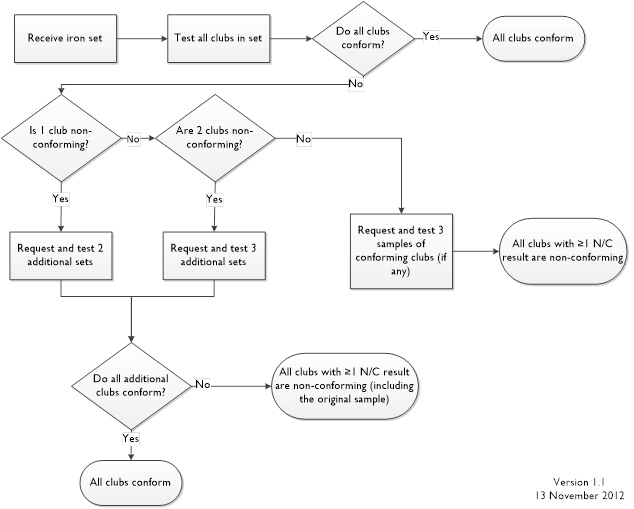
If one or more club samples within an iron set submission fails any of the standards for groove width, depth, separation, sharpness or area over pitch, additional samples may be requested prior to issuing an official ruling.
A similar procedure is applied when irons present issues with groove geometry, and in this situation, we may request a diagram of the groove design.
The flowchart in Appendix I provides the convention for the request of additional samples.
10. Fees
Conformance Decisions (Production Sample)
- Woods - $200 each
- Hybrids - $200 each
- Iron Sets - $700 per set
- Individual Iron/Wedge - $200 each
- Wedges (groups of 10 or less) - $700 per group
- Grips - $100 each
- Putters - $100 each
- Shafts - $100 each
- Others (tee, gloves, shoes, device, etc.) - $100 each
Preliminary Conformance Assessment (Mock-Ups, Prototypes and First Articles)
- Woods - $100 each
- Hybrids - $100 each
- Iron Sets - $350 per set
- Individual Iron/Wedge - $100 each
- Wedges (groups of 4 or less) - $200 per group
- Wedges (groups of 5 to 10) - $350 per group
- Putters - $50 each
- Shafts - $50 each
- Others (tee, gloves, shoes, device, etc.) - $50 each
Test Service Requests
- Drivers (CT/MOI) - $100 per head
- Fairway Woods and Hybrids (CT/Grooves) - $100 per head
- Iron COR - $200 per head
- Iron/Wedge Surface Roughness - $200 per head
- Iron Sets and Wedge Groups (Grooves only) - $350 per set/group
Expedite Requests
Expedites are possible and may be granted upon request. If available, the typical turnaround time will be 10 calendar days or less, with an additional charge of 25% of your testing fee.
11. Notification Procedure
The USGA issues an official decision notification (i.e., a certificate) indicating the conformance determination of all golf clubs and other equipment submitted for evaluation. The notification specifies the language that a submitter may use in representing the product with respect to the USGA and the Rules of Golf. The submitter is not permitted to make any statement regarding the conformance to the Rules of Golf until a submission has been made and the submitter has received the official notification. The USGA continuously improves its processes to ensure that submissions are turned around as quickly as possible. Samples of all submissions are retained for reference purposes.
Note: The USGA reserves the right to perform market check tests on clubs that have been determined to conform to the Rules of Golf. As a result, the USGA may perform such tests as necessary to ensure the integrity of its conformance decision. However, the USGA will not reverse a previously issued conformance decision prior to consultation with the manufacturer and, if necessary, evaluation of a sufficient sampling of the product (please refer to Appendix II regarding the USGA’s sampling procedure).
12. Conclusion
If you have any questions or concerns, please feel free to contact Rob Ockenfuss, Assistant Director of Equipment Rules and Conformance (rockenfuss@usga.org) or, Heather Lantz, Coordinator, Club Conformance (hlantz@usga.org).