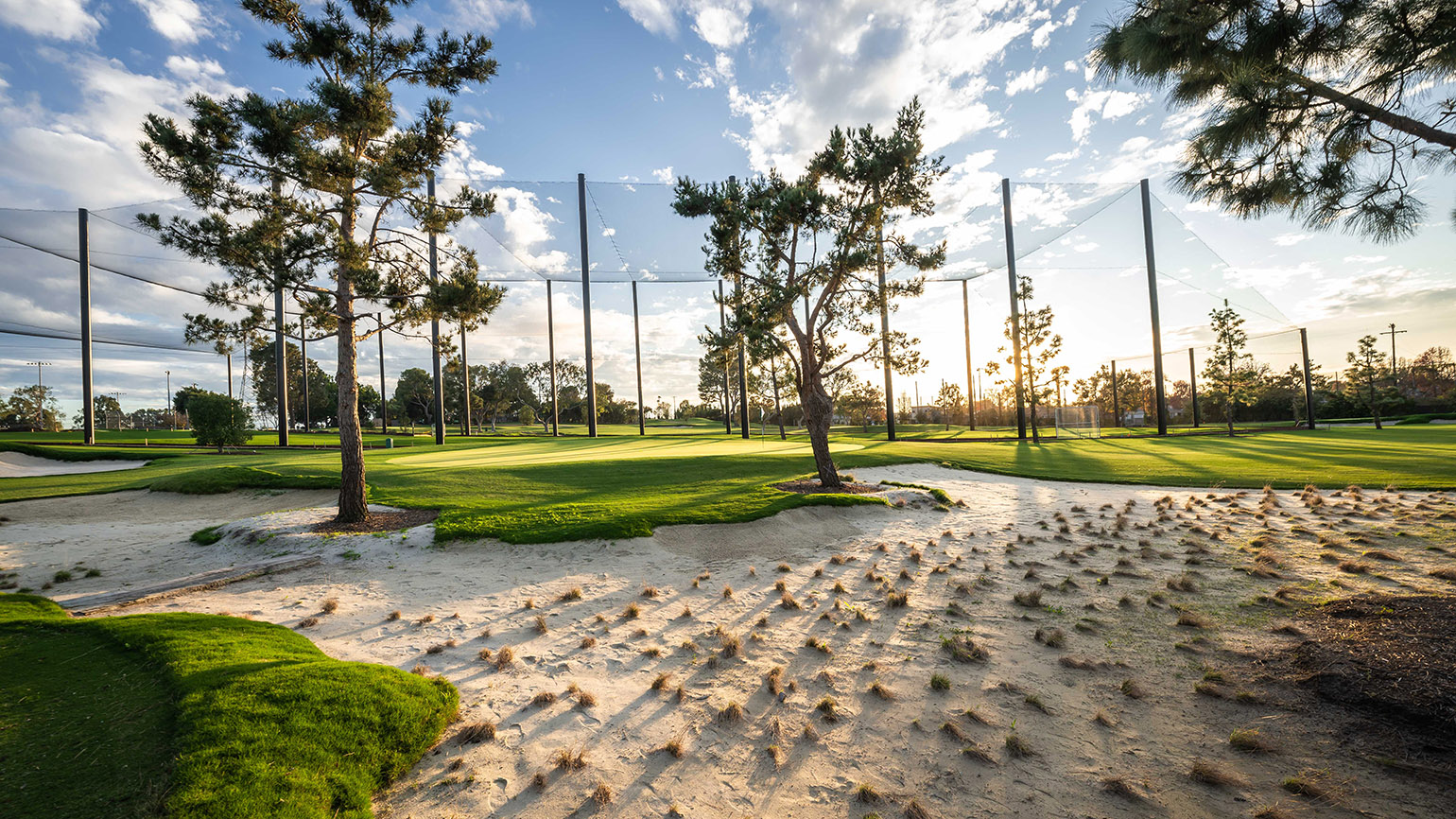


Stand on the fifth green at the newly renovated Maggie Hathaway Golf Course and take a look around. To the upper left, the Hollywood sign. Straight ahead, the Griffith Park Observatory. On the horizon, the faint outline of downtown Los Angeles. Somewhere just off the course, two red-tailed hawks circle. Below your feet, the springy give of bentgrass cut to USGA specifications. And, from the first tee, centered squarely in your sightline is the bronze-green steeple of St. Eugene's Church.
This is not the golf course people expected. When the project began, organizers were hoping to raise three or four million dollars to give a tired, nine-hole par-3 layout in South Los Angeles a modest facelift. What they ended up with, after $21 million, a Gil Hanse design done entirely pro bono, and an improbable coalition of funders that reads like a civic all-star team, is something people are comparing to the courses they have long revered.
“I’ve sent pictures to people and asked, `What course do you think this is?’” says Kevin Gigax, CEO of the newly created Maggie Junior Golf and Community Foundation. “The most common response is LACC. Followed by Riviera.”
The grand opening is March 27, with public play beginning the following morning. Still a nine-hole par-3 course topping out at 1,008 yards, “Maggie” sits tucked behind Jesse Owens Park at the corner of 98th Street and Western Avenue, just down Century Boulevard from SoFi Stadium. At $7 per round, the course had hosted some 20,000 rounds per year. That price point stays roughly the same. What changed is everything else.
Hanse, who redesigned The Los Angeles Country Club’s North Course in 2010 and created the celebrated Cradle at Pinehurst Resort & Country Club in North Carolina, came to the project after preparations for the 2023 U.S. Open at LACC sparked a conversation about golf's relationship with the communities that host its grandest events. He liked what he found. The routing had good bones. The elevation changes and natural contours were assets waiting to be unlocked.
“We don't view it as a blank canvas,” Hanse said before construction began. “We want it to remain very familiar to those who know and love it in its current condition. We're just hoping to make it better, but still Maggie.”
On-site design associate Tommy Naccarato, whose parents were married at St. Eugene's, translated Hanse's vision into reality, drawing from the architecture of classic courses. A boomerang-shaped green echoes a design you'd find on LACC's South Course. A barranca snakes through the property in the spirit of the great ravines at LACC and Riviera. The course plays firm and fast, rewarding placement over power, with USGA-spec bentgrass greens boasting some dramatica contours.
“When you rate the course,” says Dick Shortz, LACC member and general chair of the 2023 U.S. Open, “a good golfer could go around and par it with the pins in easy positions. Put them in the tough spots and the best of the best would struggle.”
The practice facility alone represents a transformation. The old driving range was a long downhill walk, difficult and inconvenient for seniors and others to access, with eight tired mats. The new range was flipped and repositioned adjacent to the first tee. It's now 130 yards deep (visitors consistently guess 180), features 18 mats, 75-foot premium netting, and an autonomous robotic ball picker, essentially a golf-specific Roomba. A 10,000-square-foot chipping and putting complex with bentgrass greens, fescue surrounds and genuine sand bunkers sit just steps away. Everything in one spot.
Fred Terrell, chairman of the Maggie Junior Golf and Community Foundation, led the fundraising efforts along with PGA Tour pro/two-time major champion Collin Morikawa, who grew up in the Los Angeles area and represented the USA in the 2017 Walker Cup Match at The Los Angeles Country Club. The USGA., Los Angeles County and Southern California Golf Association made significant contributions as well as
several corporations, foundations and individuals totaling $21 million. Latham & Watkins worked pro bono on the agreements and land issues.
“It just goes to show, when you have all these groups come together to bring a project, it's just pretty special,” says attorney John Heinz. “Seeing it happen in this community, at a place like Maggie Hathaway, which has so much history. It's really celebrating the history of that golf course and that park, and its role in the community.”